Blog Archives

Our London Meetup

Dear readers, as you know, I’ve been writing about Addy’s unique face for over a decade — the feelings of being a new parent to an odd-looking child, the laser treatments with or without anesthesia, the social interactions with humor and grace, and more.
We recently had the opportunity to travel to London (from our home in the midwestern United States) and meet some of our dear blog readers IN PERSON!
These readers are, of course, fellow Port Wine Stain families, and I am SO excited to share the experience with you here.

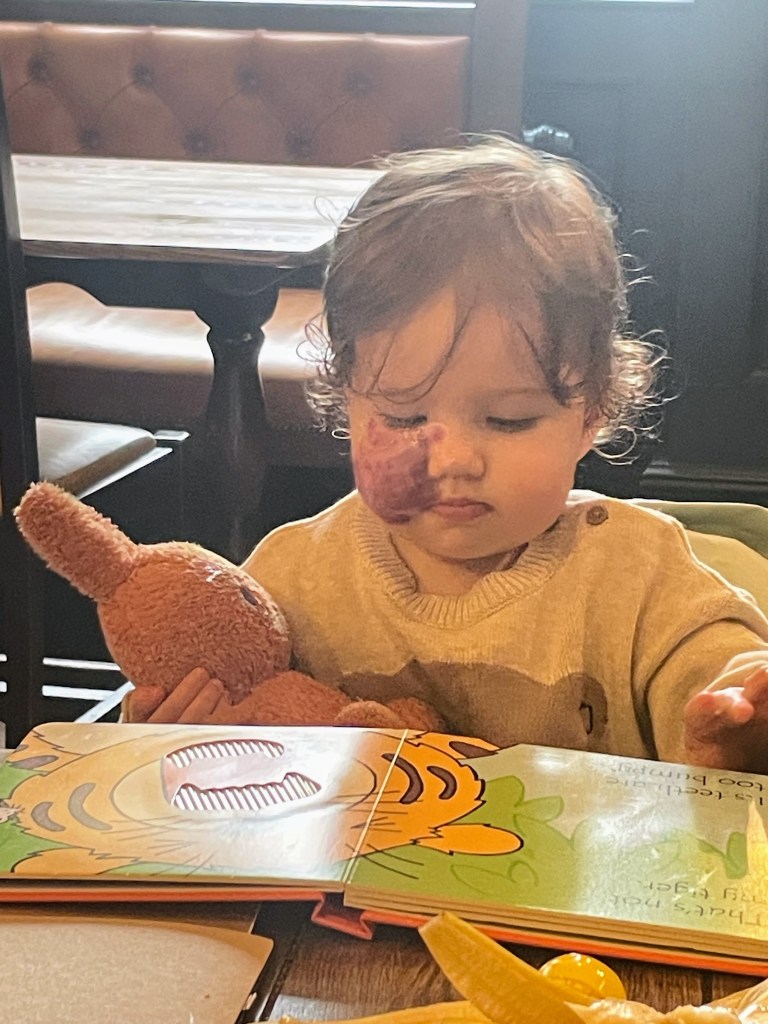
One family traveled down from Edinburgh, Scotland with their beautiful daughter, Maia. She’s a lovely little girl whose stain, like Addy’s, covers a good portion of the right side of her face. Her port wine stain had just been treated that morning — hence the purple bruising you can see in these pictures.
Maia was a trooper! Even with cross-country travel AND a laser treatment that morning to boot, she sailed through dinner, dessert, and drinks with ongoing sweetness.
Maia charmed all of us.


In addition to Maia and her parents, we also had the immense privilege of meeting — in person! — Millie Amelia, whose own Port Wine Stain experience became its own post here. She traversed the city of London to join us after work (no small feat during rush hour!).
My own parents also joined us, as did Addy’s two siblings (our other two children, Eloise and Clarence). We all met up at a quintessentially British pub on Tottenham Court Road.
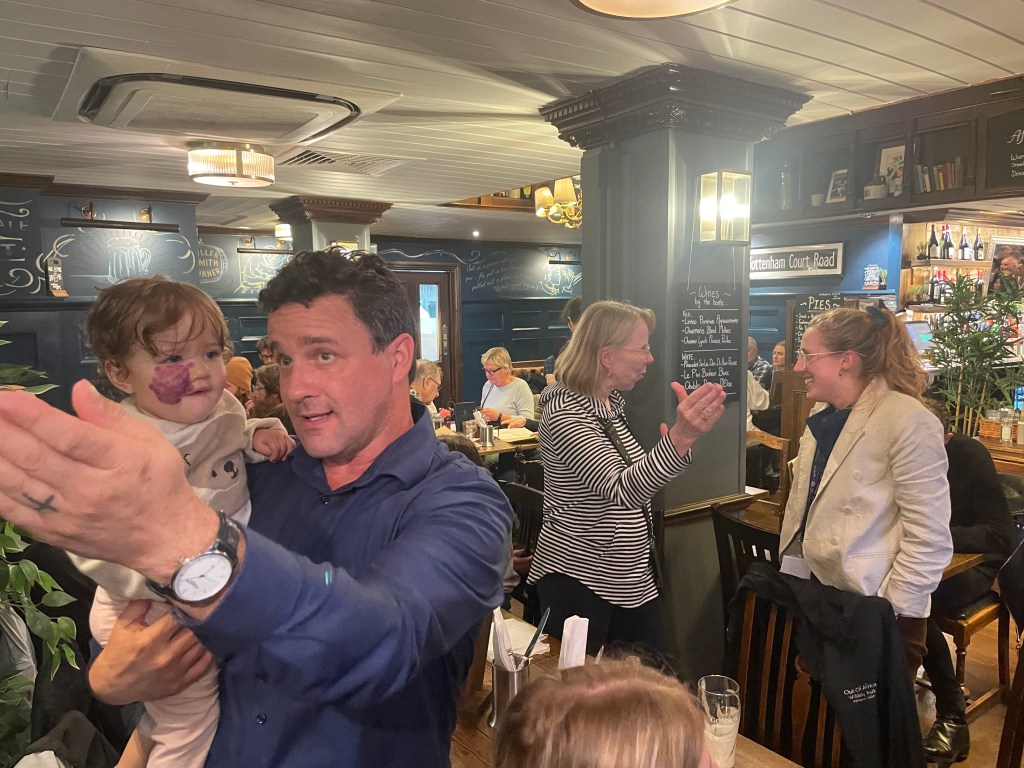

Our time together was rich. So, so rich.
It’s taken me some time to put it into words.

First, meeting in person felt like a family reunion.
It was as if we’d already known each other for years. We could feel our shared experiences without needing to figure out how to express them — experiences that are significant to us, but not common to everybody.
Maia’s parents were in good company with me and Keith as fellow parents (and even with Addy’s grandparents, too).
We’ve wondered how on earth to parent a little girl with a big blotch on her face, and keep her mentally healthy through it. We’ve pondered every angle of laser treatments, from the long-term effects of deep anesthesia to the scarring that powerful laser beams can cause on our darling daughters’ faces (which they definitely don’t need on top of their port wine stains!). And we’ve concluded that everything’s fine; these girls are fine. But it doesn’t stop us from thinking about All The Things. It’s what parents (and grandparents) do. That common ground was evident in our rich conversation.

Millie Amelia was in good company with Addy herself, as both of them are young ladies with big personalities; they also have lived the unique experience of being the only face in the room with a big blotch on it.
Millie shared with us that she’d covered her stain up with makeup for many years, and so her bare-faced confidence out in public was a relatively recent development. She and Addy have strikingly similar port wine stains — both on the right side of the face, along the V2 nerve and touching up to the forehead. Between their immediate common-ground understanding of each others’ life experiences and their similar appearance, they looked like they could have been sisters.
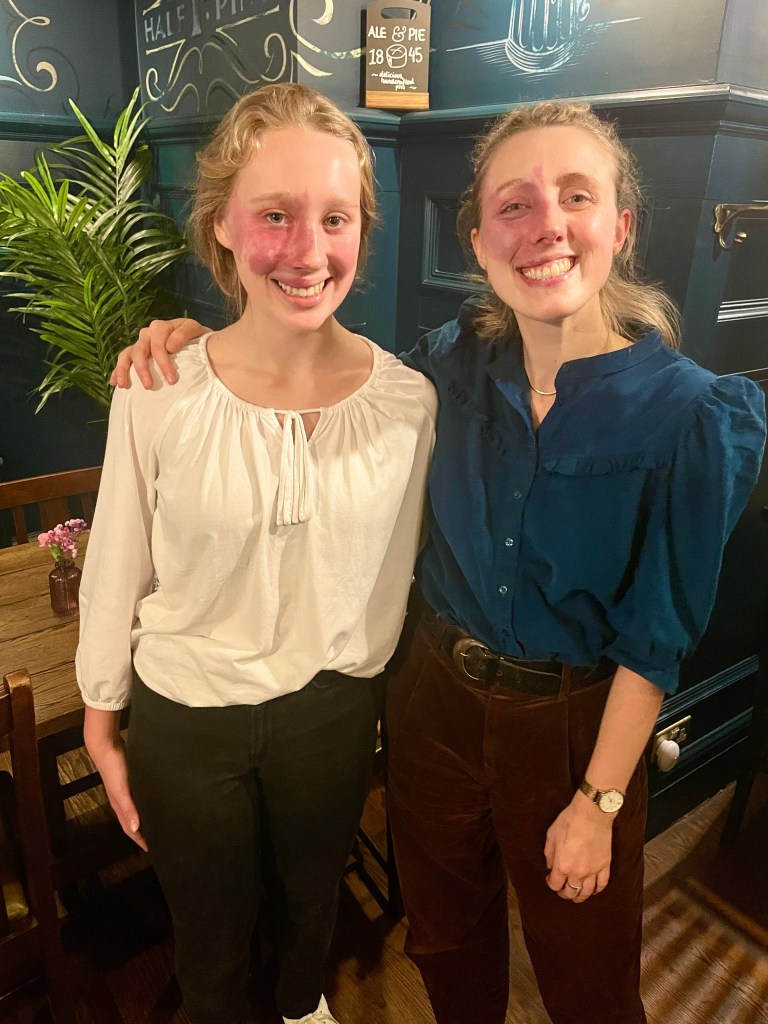

The pub was warm, cozy, and just crowded enough to feel festive. The food was comforting and good; we kept ordering one course after another: first some small bites… then, as we lingered, a full dinner meal… then, as we still lingered even more, a round of desserts… and then, after the grandparents had taxied back to the hotel and even the others had called it a night to get sweet Maia to bed, one more dessert as Millie and Addy continued their conversation at full speed like two sisters who haven’t seen each other in months and have SO MUCH to catch up on.
I lost count of how many times these young ladies would pause in the middle of their conversation, and stare at the other, saying, “Sorry, I just — it’s crazy — there’s someone here who looks LIKE me!”
Or, “I just can’t get over how there’s another face like mine at the table.”
Or, “It’s so weird to be with someone who looks LIKE me!”
Both of these young ladies were clearly affected by the presence of someone who looked just like them.
I hadn’t quite expected that.
At this point in the evening, only Keith and I remained at the pub with them (eating our second desserts). It was obvious to us that neither of them is terribly burdened by their port wine stains. They both enjoy looking different, and they’re accustomed to being unique. They’re used to being the odd face in the room, and they’re generally okay with that. They’re beautiful, confident, charming young women.
But that didn’t diminish the surprisingly profound impact of being in the room with someone who looks… like them. That was a new experience for both of them.
We’ve taught Addy over the years to find likeness in myriad ways. We’ve taught her to feel “like” another person with any similar trait, whether the trait is a similar hair style, same brand of shoes, matching article of clothing. We want her to feel “like” anyone and everyone, to push back any feelings of isolation that an odd-looking face might otherwise bring to her social encounters.
So it was a surprise to me that being in the presence of a face “like” hers affected Addy so profoundly. She was utterly delighted to find likeness — to find THIS likeness next to her, at the same table, looking JUST like her face.
“I can’t believe there’s someone else who looks like ME here!”
I heard many variations of that as the evening progressed, from both of these beautiful ladies.
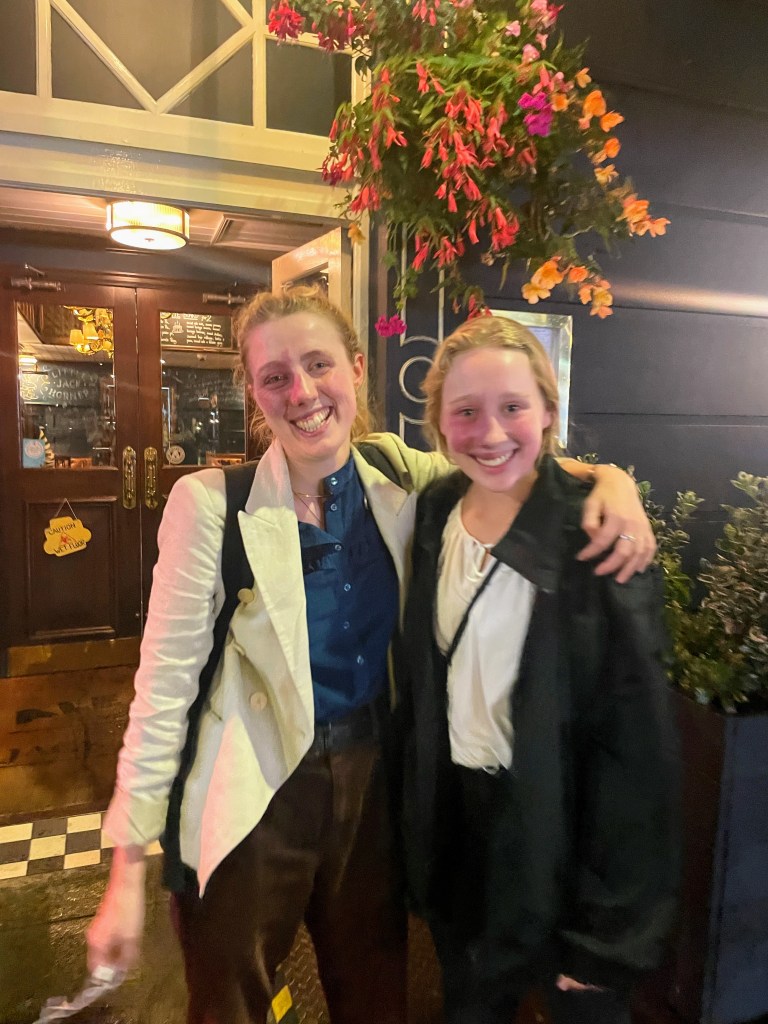
When we finally called it a night, the pub was quiet with just a few lingering patrons, and the street was dark. Addy and Millie hugged as we departed, and we said we DEFINITELY need to do this again.
We will meet up again. After seeing the impact it had on these lovely, confident young women to be with someone else who looks “just like” them, I will be pondering new ways to meet up with new friends who also look uniquely similar.
It was, in short, a beautiful experience to meet these dear readers in person.
We thank Maia’s family for making the trip from Scotland to London (travel is never easy with a little one!). Keith and I SO enjoyed connecting with other parents in person who have thought and wondered and pondered and worried the same things we have; that’s an experience we won’t forget.
We thank Millie for making the trek across London to join us. The rest of us without port wine stains — parents, grandparents, siblings — loved connecting with this articulate young woman just a few years ahead of Addy, who could share her experiences with us.
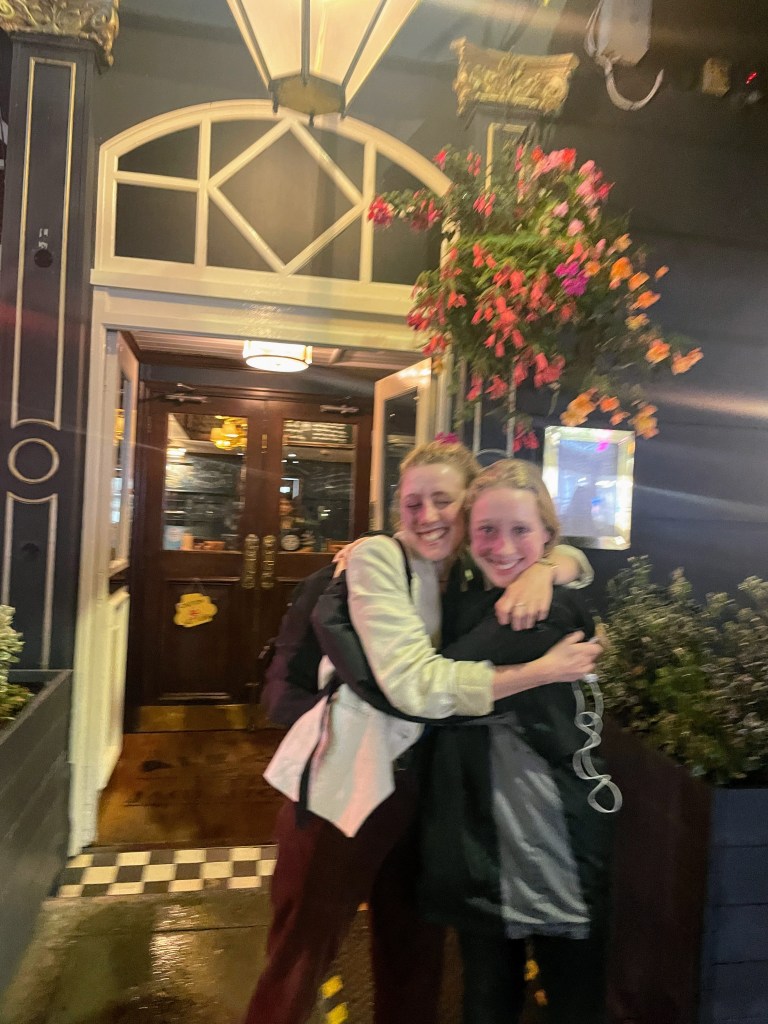
Let’s do this again sometime.
We may live in the midwestern United States, but we’re not far from the airport, and we love to travel.
Email me at whathappenedtoherface@gmail.com to let me know where you and your port wine stain live, and we’ll gladly come celebrate it with you, too. It would be a privilege.


Keeping Your Odd-Looking Teen Safe From Online Bullies
It can be a scary thing to raise an odd-looking child.

In the best of circumstances, we come to parenting already loaded down with our own memories, baggage, and fears. Then, when we meet our darling baby and find that they look… well, unique… we suddenly worry a thousand times over that this child will be the target of every bully and the butt of every joke for the rest of their life.
It can be overwhelming.
But over time, and day by day, we equip our child to handle the loud questions, the finger-pointing, the snarky comments, and the mean encounters with humor and with grace.
This takes a lot of intentionality: talking about every encounter; equipping her to answer the questions herself; going out into the world together — a lot.
And with time and effort, we find ourselves satisfied that they’re growing into a well-rounded, socially empowered, and uniquely confident individual.
But… that’s just real life.
That doesn’t even begin to touch on virtual life.
Addy was very young when social-media culture took off like a rocket. Constant comparison, airbrushed photos, self-loathing of flaws, body insecurity… it became rampant among teens, and I was deeply concerned about launching a soon-to-be-teenage girl with an odd-looking face into that world.

Her childhood was also the era when younger and younger kids were being given devices like iPads and cell phones to occupy their attention and connect them to the world — for better and for worse.
There are enough heartbreaking stories of bullying in real life; opening up the portal to connect our odd-looking daughter to the seemingly infinite flow of virtual bullies, too, was a gamble we didn’t want to stake her development on.
So, in a rather unusual move among our peers, my husband and I decided to NOT get Addy a cell phone.
This means that Addy is now sixteen, and she STILL has no cell phone.
No iPad
No phone number.
No social media accounts.
Obviously, we’re not anti-internet; I’ve been blogging about Addy’s face for years, and my husband and I both have multiple devices ourselves so we can access the internet 24/7. But our children don’t — especially the odd-looking one who stands out.
We had other reasons to keep devices away from our kids, too: our increasing awareness of the impact of screens on cognitive development, strong addictive tendencies in both our family lines, our own lost hours scrolling, and a high value on real-life interaction skills. All of these things made us a natural fit for analog parenting.
But Addy’s face was definitely a big factor. A young girl’s confidence is already on shaky ground in the best of circumstances. Bullies are already a risk in real life for a girl with an odd face. For us, it was critical to control the flow of comparison, trolling, and negativity into Addy’s developing brain and character by limiting her engagement with the world to real life. We simply closed the door to the infinite virtual world. We’d heard too many horror stories.
An Important Note: Please know that we do NOT judge you if you make different choices. We have MANY friends who need to equip their kids with communication devices for various reasons! I’m simply sharing our experience here of making the choice to leave that can of worms closed entirely.
When other parents find out that our kids don’t have cell phones, the first question we field is this:
Hasn’t that kept her unplugged from vital connections and aspects of our now-so-virtual life?
Well, let me answer that with a story.
Once upon a time, recently, Addy was involved in an activity, and the adult leading the activity set up a virtual group chat for all the girls. (This adult is savvy & awesome and did everything right.) Addy, who did not have a cell phone (and still doesn’t) missed out on the group chat. She was not “in the know”.
Sounds terrible, right?
Missing out on virtual social interaction with her peers?
In these formative teen years when friendships are everything?
Yikes!
I recognized this disconnect, and I took Addy aside and said, “Listen hon, I’m really sorry. I know your friends are all connecting on this channel, and you’re missing out, all because your dad and I won’t get you a phone. That can’t be easy, and I just want you to know that I see that.”
She laughed at me, shook her head, and told me what she was really missing out on:
Within hours of this awesomely intentional adult leader setting up the supervised group chat… a “shadow chat” was set up, which included all of the female peers… except one. They picked a girl they didn’t like, and excluded her from the group chat. And this shadow chat became henceforth the primary channel of the girls’ communication.
Addy, not being part of this virtual group of females, was not part of this exclusion. She wasn’t part of the singling-out. She wasn’t herself singled out & excluded. She missed out on the alienation. She missed out on extra teen-girl drama and politics (as if real life doesn’t bring enough of them!).
So while I am no parent’s judge – you do what works for you – if you can avoid the phone, please do. It will help your unique-looking child avoid that whole extra universe of “Even More Ways To Be A Stinky Teenager” (with all its accompanying messes, insults, comparisons, gossip, and exclusions). Real life has enough of that stuff; spare your odd-looking kid the extras, if you can.
We have many dear friends who struggle daily with their teenagers to stem the flow of negativity coming through their handheld portal to humanity’s cesspool. They set up blocks; they turn off their wi-fi; they add trackers; they search histories; they read texts… and they’re exhausted.
But avoiding that portal altogether is, in my experience, a simpler — if rarer — choice, and it’s one I heartily recommend for anyone launching a unique-looking teen into a world full of stinky humans.
It’s not that avoiding a phone will avoid all the drama. All the same dramas exist in real life; they just come in more manageable doses in any given day, because they’re limited to physical reality. (There are only so many humans we can encounter a single day. But virtual access is practically infinite.)
Avoiding the phone can help you stem the flow of overwhelming negativity long enough to help your unique-looking child make it through these vulnerable years of cognitive development with her identity and self-esteem intact.
Fun fact: We did recently break down and get a phone for our three kids (ages 12, 14, and 16)… but it wasn’t quite the phone they had been waiting for:

It’s right there in our kitchen / dining room / living room. (We have a small house, so it’s in the middle of EVERYTHING.)
Even the dog conspires to listen in to the teenagers’ conversations.
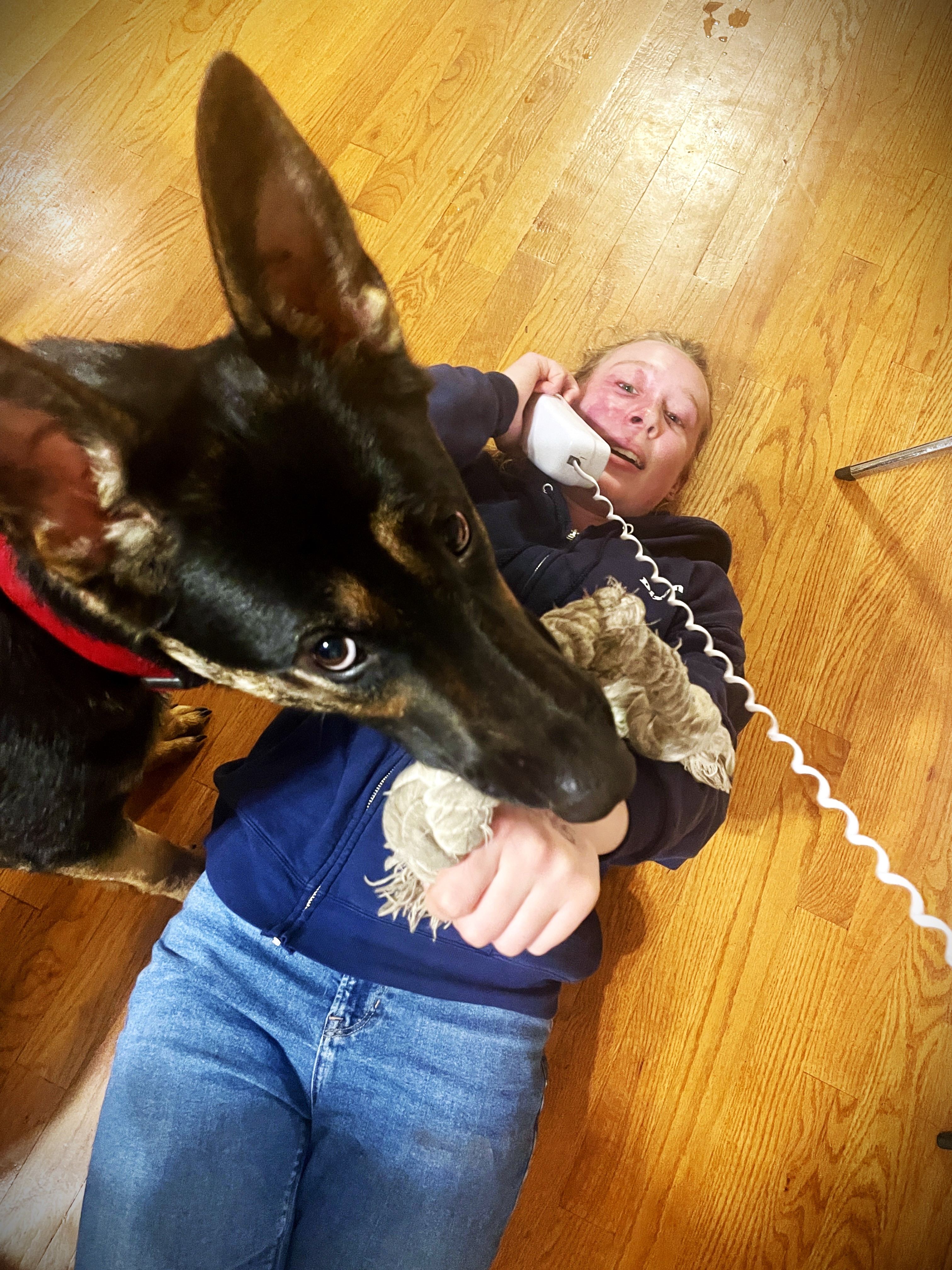
There have been moments, as above, where I’ve questioned the wisdom of keeping our kids out of the world of virtual interaction with their friends. But then, without fail, those virtual interactions unnecessarily go sour (exponentially more than in-real-life interactions going sour), and we’re reminded that it’s still okay to make our kids focus on the real world for now.
The real world has enough stares, questions, pointing, and sneering. We simply wanted to keep Addy (and her odd-looking face) shielded from an endless stream of more of it. And it’s turned out to be a fabulous choice for all three of our kids.
(Our 12-year-old daughter doesn’t agree, but she’ll be fine.)
So if you’ve been waiting for permission to stem your kid’s handheld access to the cesspool that is the modern internet… consider it granted. Your child might balk, whine, beg, or cry. That’s okay. They probably did that when you wouldn’t give them an entire jar of frosting to eat at once, too, because you were looking out for them. You do what’s best for your kid, even if they don’t like it.
And if you want them to exclusively focus on the real world now, then you can. It’s still the real world. Empower them there now. Teach them how to communicate and handle conflict in the real word. Teach them how to make eye contact and have a conversation. Teach them to observe the world around them and be aware of each situation. These skills aren’t easy for anyone to learn, and it can require even more daily intentionality when you add an odd-looking face to the mix.
These skills will translate to the virtual world at the right time, too. Your child will be perfectly capable of carrying on with life virtually when they’re ready to get their own personal portal to that world. But they will have skipped a lot of unnecessary heartache and drama and energy drains and time drains along the way, especially in that oh-so-tricky time of awkward teenagerhood and social drama.
I do find it funny (and perhaps ironic) that Addy’s face has been plastered on the internet for over a decade now. I’ve been blogging about her and posting pictures of her for many years. Obviously, I’m not averse to the internet; I love connecting with all of you! I’m more pragmatic than paranoid.
Therefore, this isn’t a matter of sheltering my kid from reality; it’s simply a matter of helping my child develop into the human she has the potential to become, without the trolls of the world having unlimited access to cut her down 24/7 in this most vulnerable time.
In all, it’s been a remarkably simple and easy way to keep our odd-looking teenager safe from online bullies: don’t allow them a portal to her at all.
No site-tracking, no time-blocking, no contact-tracing, no erased-history-recovering, no negotiating, no internet controlling, no Wi-Fi-password-changing, no text eavesdropping, and no long letters to senators about how dangerous Meta is to teens.
It’s been absolutely delightful.
If you have any questions about getting to (or through!) the teen years, please feel free to reach out & leave a comment below. I love hearing from and connecting with other parents like you, and I’d be happy to share more of what’s worked for Addy!
P.S. Yes, she has her driver’s license, and she’s driving. Without a cell phone. She has to know the route ahead of time. Like we all had to, once upon a time. 😁🚗🗺️📌
P.P.S. Yes, we sent her off with a group to travel for a couple of weeks this summer, and they traveled to Europe. So she traveled to Europe without a cell phone. Her birthday present ahead of that trip was a digital camera so she could take pictures. I didn’t know exactly where she was at every minute; she was fine with that.


Glaucoma-Free (so far!)
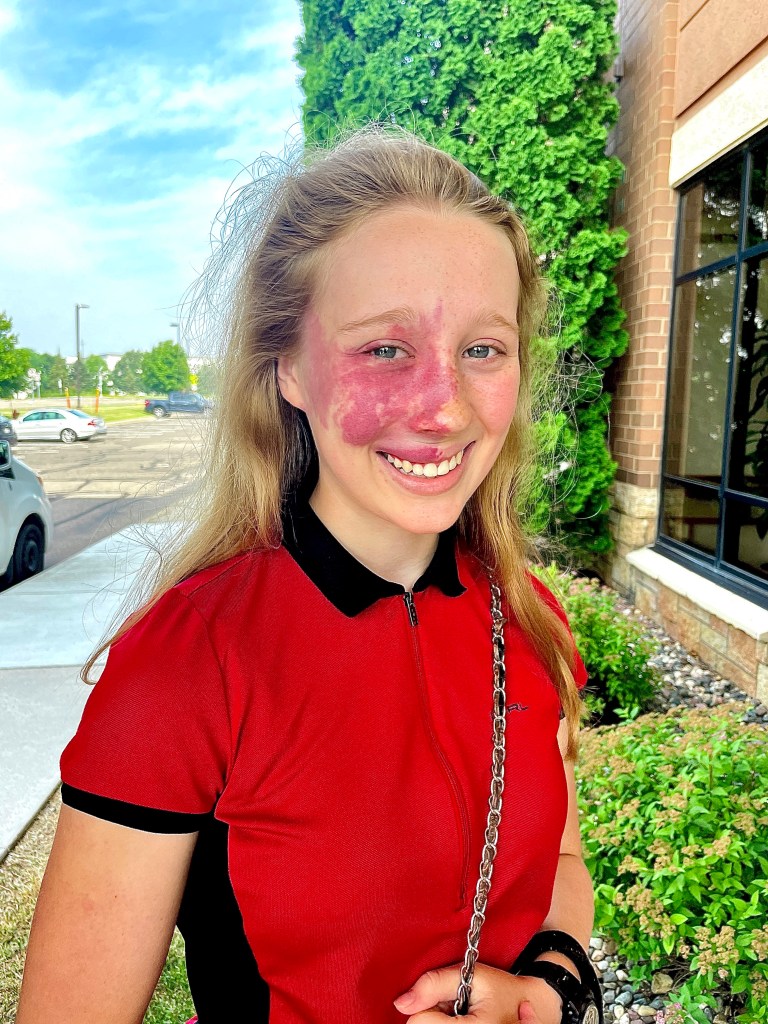
When a port wine stain reaches up to the eye, some unique complications can result from the hypergrowth of blood vessels.
Because the blood vessels grow with the child, they continue growing ever bigger as the child grows. When the port wine stain crosses over the eye, this can lead to increasing pressure, or glaucoma. (I’ve met some port wine stain peers who have had glaucoma since childhood!)
Addy has been regularly checked for glaucoma since she was tiny, and the good news we got from her most recent ophthalmology appointment… is that she is glaucoma-free! Her eyes are working fabulously, and there is no additional pressure detected. This makes mom VERY happy. If she’s glaucoma-free now, then she’s probably in the clear. (She’ll still get checked throughout adulthood, but it’s much less of a concern as her growth slows down.)
Glaucoma hasn’t been the only concern, of course. Those big blood vessels in overdrive can cause other things, too — some of which are actually kind of funny.
In Addy’s case, when she was little, the overgrowth of blood vessels inside the port wine stain effectively close off her tear-drain-duct on the right side, causing regular overwatering of the right eye (when her normal ‘tears’ keeping her eye moist had nowhere to go). She looked like she was always crying, but only out of one eye!
To treat this, her ophthalmologist simply inserted of a drainage tube down below her right eye. They simply did this during a routine laser surgery, since Addy would already be under anesthesia. It helped to re-open the drain, and the excess tears on the right side were resolved. Easy, done.
Complications from her port wine stain will always be a concern, but as Addy gets older, our concerns shrink further. As her growth slows down, her Port Wine Stain slows down its growth, too.
(Of course, all bets are off at pregnancy, when growth goes into hyperdrive again! I know one woman who got zapped every month during her pregnancy because her Port Wine Stain started growing again like crazy.)
I expected the teen years to bring more concerns, not fewer — but as far as Addy’s face goes, it’s been nice to breathe a sigh of relief and see some of these worries settle themselves out. Her teeth (pushed to the side with all that extra blood flow and early growth on the right side) have been straightened with braces. Her right eye’s tear drain is fixed and draining normally, no longer overwatering. And her ophthalmologist says that we can pretty much not worry about glaucoma, since she’s in the clear there already.
So to all the parents out there of port-wine-stained littles, I can tell you that one by one, your worries will settle, and the menu of possible complications you might have to deal with — which seems overwhelming now — will shrink as your little one grows. There will be LESS to worry about, not more, as you reach new milestones and check these things off your list.
Your little one will be just fine.

Laser Treatment #44 for her Port Wine Stain
Addy recently underwent her forty-fourth laser treatment for her port wine stain!
Port wine stains like Addy’s need to be treated regularly, much like weed-whacking in a garden or yard. This is because the crazy overgrowth of blood vessels that originally created the port wine stain in utero also continues to grow with the rest of the body throughout childhood.
The laser treatment, in simplest terms (because I’m a mom, not a doctor), shoots a hyper-focused beam of light at the port wine stain; that light is absorbed by the blood vessels, which heat up and die. (Their bursting is what causes crazy purple bruising after a laser treatment.)
But port wine stains vary in their depth and breadth. If the error occurred early in utero while the body was developing, then the port wine stain will be deeper and/or cover more skin; these are harder to treat. If the error occurred later, then the port wine stain will be shallower, and probably smaller in size; these are easier to treat.
The lasers can only sizzle up & kill the top layer of blood vessels. So a deep port wine stain with a lot of layers of overgrown blood vessels will be tougher to treat; they’ll appear to be “resistant” to treatment, when in fact there are just a ton of layers to zap through.
It doesn’t help that the child’s natural growth fuels further blood-vessel growth, too — and that’s why port wine stains get thicker and darker and (and perhaps bring more complications) with age.
So between the deep layers and the constant growth, Addy’s treatment schedule has looked a lot like weed-whacking in an overgrown garden. We would take a whack at the overgrowth of weeds, then wait a month, and then take another whack at the next layer.

Addy’s first treatment happened when she was five weeks old, under full anesthesia. She continued to go to Children’s Hospital outpatient surgery almost every month for the first few years of her life, in order to get laser treatments for the port wine stain on her face.
Her stain was stubborn and deep! If you’re reading this and you have a baby with a port wine stain, please don’t fret — many port wine stains are NOT as deep as Addy’s, and they can go away with fewer treatments.
(And if you’re still worried that it won’t go way, you can read about Addy’s fabulous encounters with other humans here, here, and here, which only happened because her port wine stain was so visible! There are perks to being noticeable!)
Now that Addy is sixteen, she’s decided that she loves the shape and shade of her port wine stain, and wants to leave it just as is.
This means that she’ll need an occasional ‘maintenance’ treatment to contain (weed-whack!) its growth, but otherwise the treatment schedule has slowed down to maybe once a year.
This most recent laser treatment was unique: it was done in the clinic, and not in the hospital under full anesthesia.
This was new for us; her first 43 laser surgeries had all done at Children’s Hospital under full anesthesia. (This is because squirmy small children + big loud blinding laser machines pointed at their faces = sedation!)
For laser treatment #44, she saw the same dermatologist, but we went to his clinic for a quick procedure (no anesthesia).
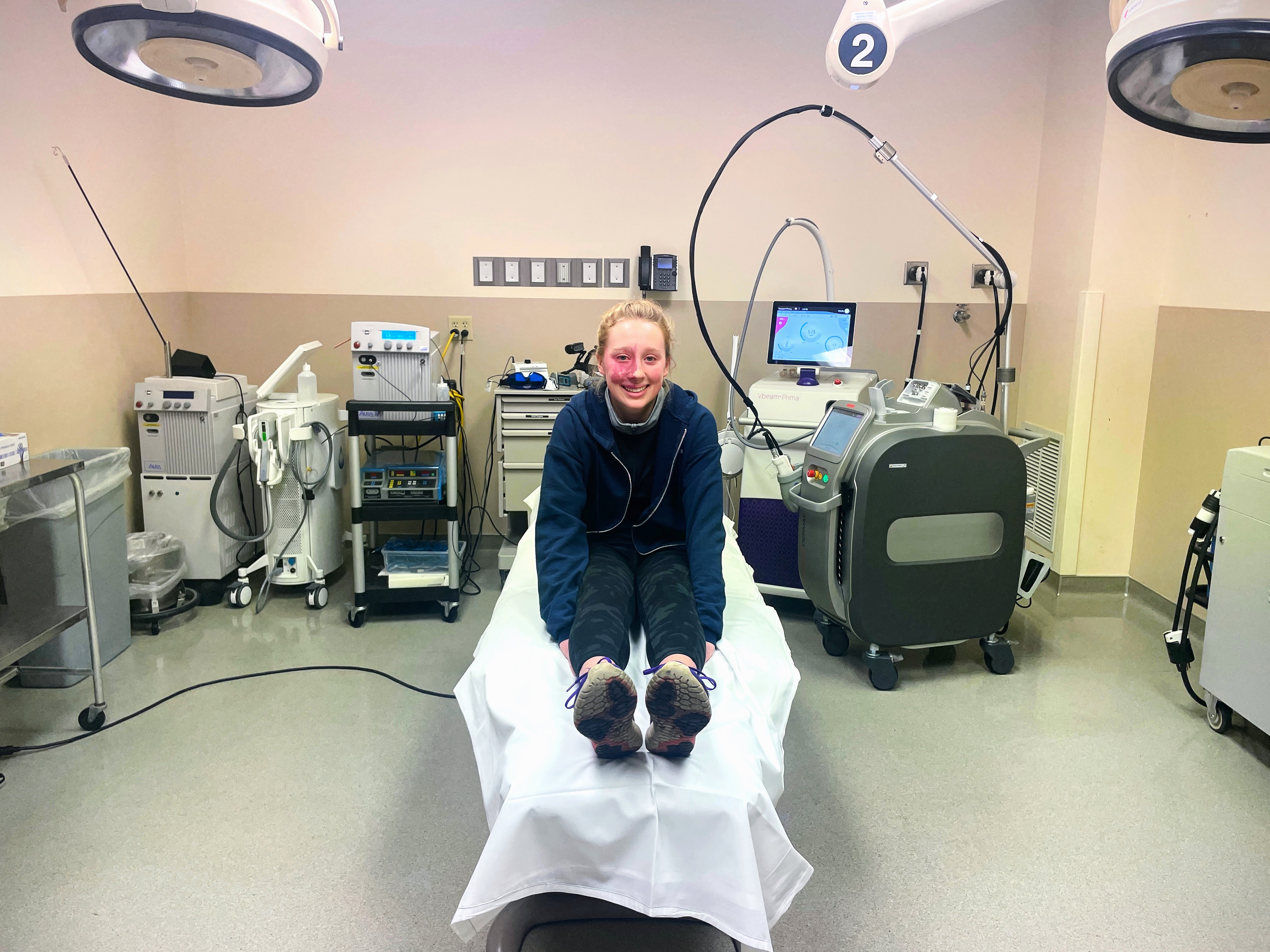
Addy was a little bit scared going into this treatment, even at her age. She was nervous that the laser machine would be loud and would hurt her face.
She wasn’t wrong. The machine makes a loud zapping sound, which is a bit unnerving when your eyes are covered with a protective shield so you can’t see what’s coming. And the laser feels like a rubber band snapping the face a hundred times a second, so it’s not exactly painless.
But it was SO fast. She was done in about fifteen minutes. Easy.
And being a teenager, she grabbed my phone and took a selfie. Because, cool face.

So while she definitely prefers to be knocked out cold for the procedure, she appreciated the speed with which we were done. And there was no ‘anesthesia hangover’ (which can make a person a little wobbly emotionally and otherwise for a few days afterward). And there was no need for a pre-op physical (which is necessary within the week before they’ll be going under full anesthesia). I appreciated the simplicity of it all.
There are definitely perks to both treatment approaches (under anesthesia and in-clinic). Sometimes insurance guidelines or treatment availability dictates one approach over another, and you may not have too many options.
But either way, they work, and we’re grateful for it.
If you’re looking ahead to treatment options and you want to get into this a little bit deeper, please leave a comment below and I’ll be happy to answer any questions you have!

Thank you, and Happy Vascular Birthmark Day!
Addy informed me recently that we’re in Vascular Birthmark Awareness month (the month of May)! And apparently, on May 15, people put red hearts on their face or body wherever their loved one has a vascular birthmark, like a port wine stain or hemangioma. (Check out the difference between port wine stains and hemangiomas here.)
In a spectacular parenting faux pas, I totally forgot that this was coming. I got busy with other things as May 15 drew closer. My head was filled with all the things I had to do, like Zoom meetings with clients. And I forgot about Vascular Birthmark Day.
Until that day.
Addy asked me that morning: “MOM! Are you going to do the thing where you put the red stuff on your face?”
Me: “Honey, I have zoom calls today, I can’t be just putting something weird on my fa-“
[Realizing she was talking about vascular birthmark day, where people put red hearts on the spot their loved one has a port wine stain…]
[Awkward silence…]
Me: “Hand me that lipstick.”
And that’s how I ended up in meetings with a big red thing on my face (just like Addy)!
At School
When I dropped Addy off at school, her school director, Mr. Martinez, asked me for the story behind the heart on my cheek. I told him about vascular birthmark day for Addy… and that’s how Mr. Martinez ended up with a heart on his face, too!

And then… Addy’s friends added hearts to their faces.

And then… friends of Addy’s friends got in on the action, and added hearts to their faces, too.
And then… other teachers asked their students why so many kids had hearts on their faces, so they asked to be hearted-up, too.
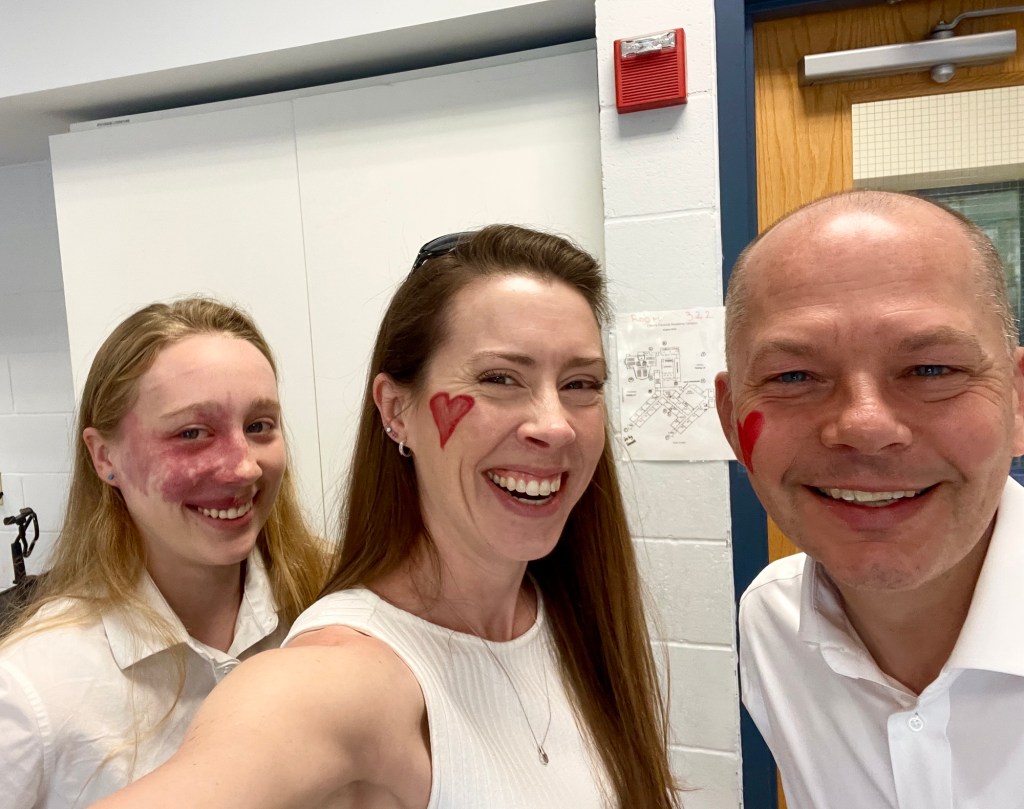
And so, by the end of the day, there were A LOT of students, teachers, and staff with red hearts on their faces, for Addy’s sake.
Even “Francis the Mouse”!

I cannot overstate my awe at the love this community shows. I see it all the time as this little school community comes together for each other in different ways. I know the humans here are awesome. But the sheer volume of love we receive from them never ceases to amaze me.
When Addy was born, I feared for her. I feared that she’d be the easiest bullying target in the room — in every room she’d ever walk into. I feared that the pointing, the stares, and the poking of her face she was receiving regularly would make her want to hide away and not be seen. I feared for her confidence, for her mental health, for her perspective of her own beauty.
And while Keith and I have done a lot of work to get her to this point where she’s sixteen, confident, and comfortable (which I’ll write more about soon), we haven’t done the work alone. We haven’t walked this route alone. At every step, we’ve been accompanied by teachers, friends, staff, grandparents, extended family, and hundreds of other people who have spoken life and love and beauty into our odd-looking daughter’s ears.
This May 15 was overwhelming for this mom.
To everyone who put a heart on for Addy, thank you.
Thank you.

Parenting Strategy #9: Be Honest About the Error
Parenting Strategy # 9: Be Honest about the Error
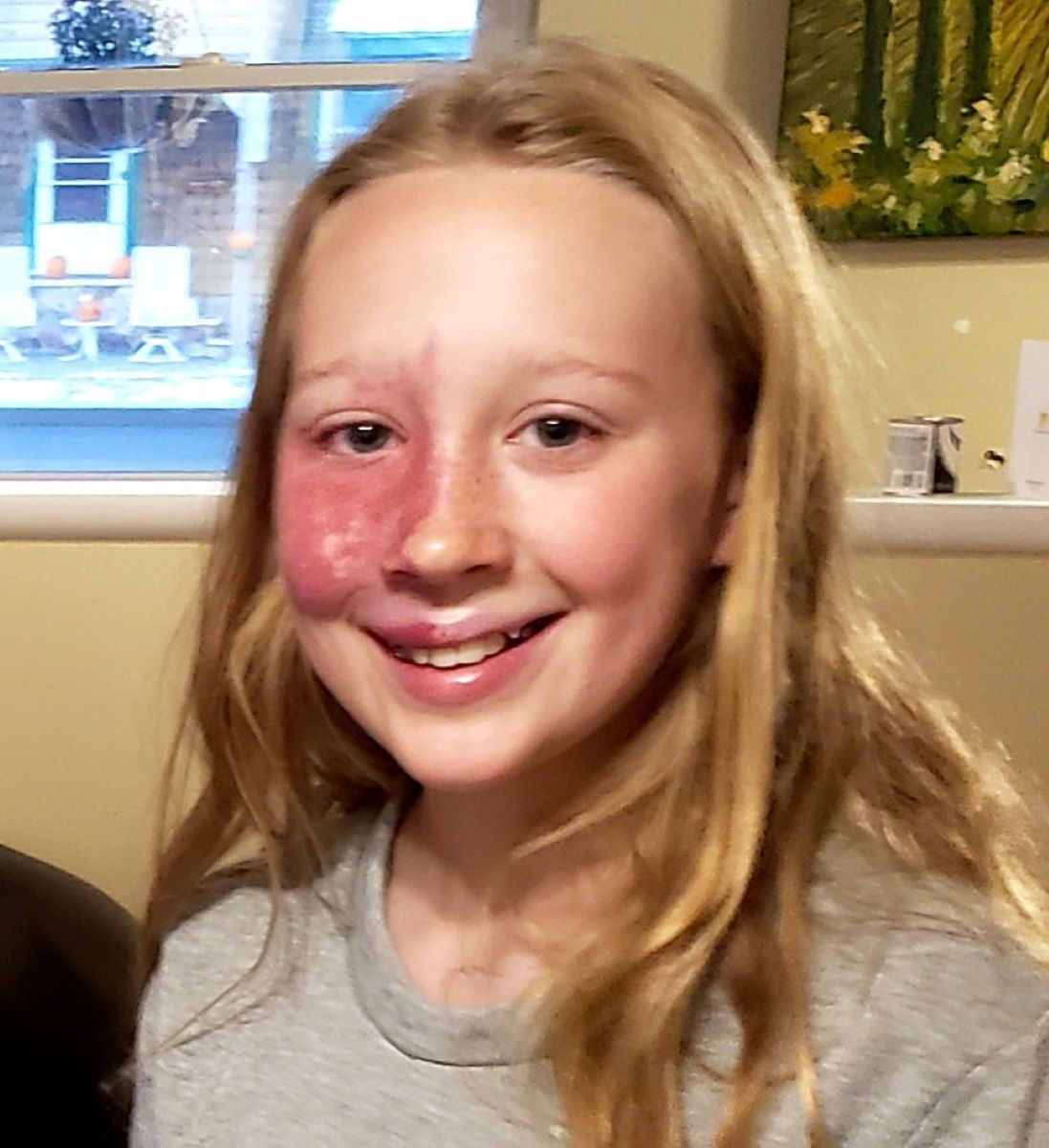
In my last post, I said that it’s important to treat facts neutrally. Your child needs to know the basic facts about her face: you have a birthmark. The birthmark is a port wine stain. A port wine stain is extra blood vessels.
And (are you ready?): That birthmark is an error.
The port wine stain is an error. Something went wrong in utero, and the nerve that was supposed to send a signal to its related blood vessels to “Stop growing!” never did. So they kept growing, even though they weren’t supposed to.
That’s not negative commentary, it’s a fact. And we face that fact honestly and neutrally.
Let me stress that – you must be neutral when you’re honest! You don’t mope, groan, cry, exaggerate, or sigh when pointing out that an error occurred. It’s simply a value-neutral fact. It’s an error.
I can’t tell you how important this is. It is the foundation of grace. Addy knows that she’s beautiful and that she’s fearfully and wonderfully made, and that she is not perfect… Because no human is.
Let me repeat that: no human is perfect. That is the message your unique child needs to understand to the depth of their soul. We all have errors. None of us is living in the Platonic ideal of a human body. We have moles, we have quirks, we have genes, we have illnesses, we have mutations – many of them just too small or out-of-sight to notice. Someone like Addy might wear their error front & center, but everyone is flawed, somewhere, somehow.
That’s why the fact that a port wine stain is technically an error doesn’t have to be negative. I’m flawed, you’re flawed, everyone is flawed! Her port wine stain doesn’t have to be ‘better’ or ‘worse’ than any of your features. It simply is.
We can, and should, learn to appreciate the beauty in other humans’ traits, many of which are themselves errors. (Even adorable freckles, after all, are little bits of pigment gone awry.) But remember that you don’t have to erase the fact that an error exists in order to call it beautiful.
We’re afraid that if we call a feature less than perfect, we’re somehow being negative or derisive. And so we call it perfect instead – as if anything less than perfect can’t be beautiful.
But it’s okay to acknowledge an imperfection, even to the point of working to fix it with powerful lasers, and also see the beauty in it all the while. It’s not either-or. It’s both-and.
Don’t be afraid to call that beautiful birthmark an error. It may actually, unexpectedly, feel validating for your child to know that yes, something went wrong, and that’s okay. She doesn’t have to feel ‘perfect’ about it. This isn’t a big deal. Everyone’s got something. And even while the laser surgeries make progress on fixing the error, she can feel beautiful with it all the while.
As your child understands that this birthmark is an error, she may start noticing all the other errors around her. This is healthy; she’s finding camaraderie. Addy loves knowing that my spine is shaped like a long ‘S’ from scoliosis, and that her dad has a dark birthmark on his side. She loves finding strange markings and alopecia and missing limbs around us. Because she knows that everyone’s got something a little ‘off’, and she thinks that’s pretty awesome.
So when you’re talking to your child about their birthmark, go ahead and be honest about the fact that it’s an error. It’s an error, and that’s okay. That doesn’t mean it’s not beautiful; it’s absolutely beautiful. It simply means that she’s not perfect.
Which means, really, she’s just like everyone else after all.
.

.
A few other “Strategies for Parenting a Unique Child”:
Parenting Strategy #8: On Talking
Parenting Strategy #7: Get Out
Parenting Strategy #6: Find Likeness
Parenting Strategy #5: On Makeup
Parenting Strategies, Part 2: On Beauty
A Few Parenting Strategies…

Parenting Strategy #6: Find Likeness
Continuing my theme of “Strategies for Parenting a Unique Kid” (see #1-3 here, #4 here, and #5 here)…
Here’s one for combating a very real fear facing (no pun intended) parents of strangely-marked kids:
Parenting Strategy #6: Find Likeness
One of the fears we face as parents of odd-looking children is that our darling baby will grow up to feel isolated in their uniqueness. Marked with something like a big port wine stain, they’ll probably be the only such face in every room they ever enter, throughout their entire lives.
Being noticed is occasionally fun, like winning an award or hitting the red carpet, but the thought that your child will never not stand out can be overwhelming. And not a bit isolating; after all, we often find camaraderie in other humans who are (or look) ‘like’ us.
There are a few ways to help your child combat those feelings of isolation.
One way is to teach them to intentionally find likeness with humans who are similar in a hundred other ways. Their faces may be different, but they do have other things in common, if you know how to look. Maybe she braids her hair like that one girl from dance class. Maybe he likes soccer, just like the kid down the street. Or maybe her sneakers are green, like the kid in the grocery store aisle.
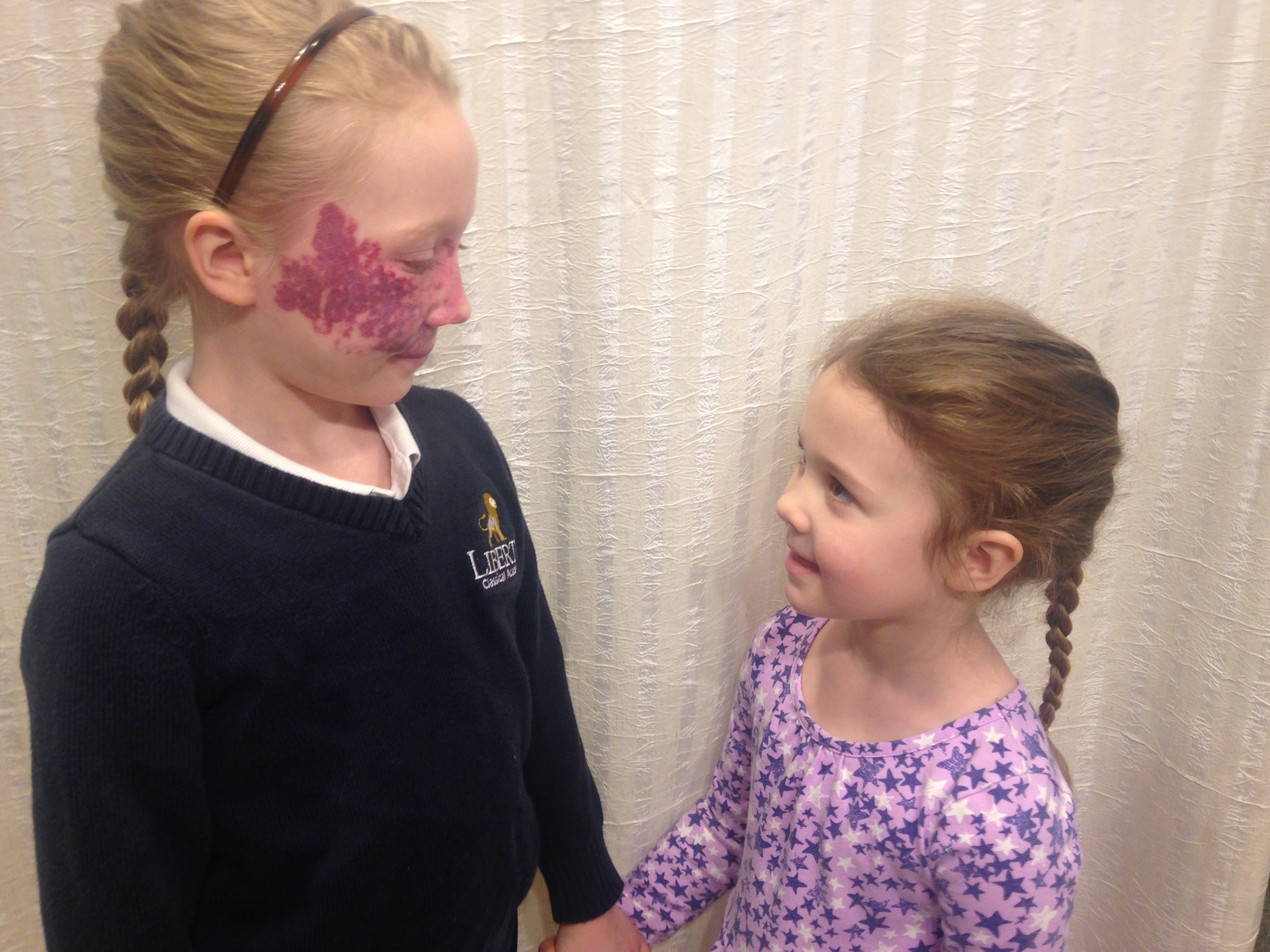
Any common ground you can find shared between your child and another person is excellent material for pointing out natural camaraderie, and staving off any possible isolationism. Teach your child the valuable skill of spotting likeness in other ways, perhaps small or unexpected. There’s always something, even if it’s not obvious to them; point it out often!
Another way is to widen the scope and find likeness in other different humans’ eye-catching features. Addy walks up to lovely bald folks with alopecia and talks about how it feels to look unique. She thinks that veterans with missing limbs are pretty much the coolest guys, ever. She feels solidarity with her cousin in a wheelchair, because he’s noticed, like, even more than she is! These other humans may not look like her, but she feels ‘like’ them in being unique.
But your child may still feel isolated at some point, knowing they’ll rarely, if ever, see another face like theirs.
So… when you can’t find their likeness in any other humans, you find it in non-human places instead! Examine your child’s unique feature, and start finding it in the world around you, even in unexpected places.
Our port-wine-stain radar picks up anything, anywhere, that might resemble a pink, red, or purple ‘splotch’ on a pale Nordic background. Here are a few things we’ve found:
Cupcakes: Addy’s birthday falls near Valentine’s day, and her classroom-treat cupcakes always bear some combo of pink and white frosting – but these were, by far, our favorite. Port-wine-stain-face cupcakes: half pink, half white!

Flowers: The kids picked out flowers for planting in our garden one spring, and the girls picked out petunias. Eloise told Addy she should get the “port-wine-stained petunia” (like this one), and so Addy gleefully planted the special flowers that ‘looked like’ her face:

Stuffed animals: Addy’s favorite stuffed cat happens to have a big pink mark, just like her face:
Sequins: Eloise flipped exactly half of her magic-sequin sweatshirt so that one half of the dog’s face is a different color than the other half, and proudly showed big-sister Addy the “face like yours!”
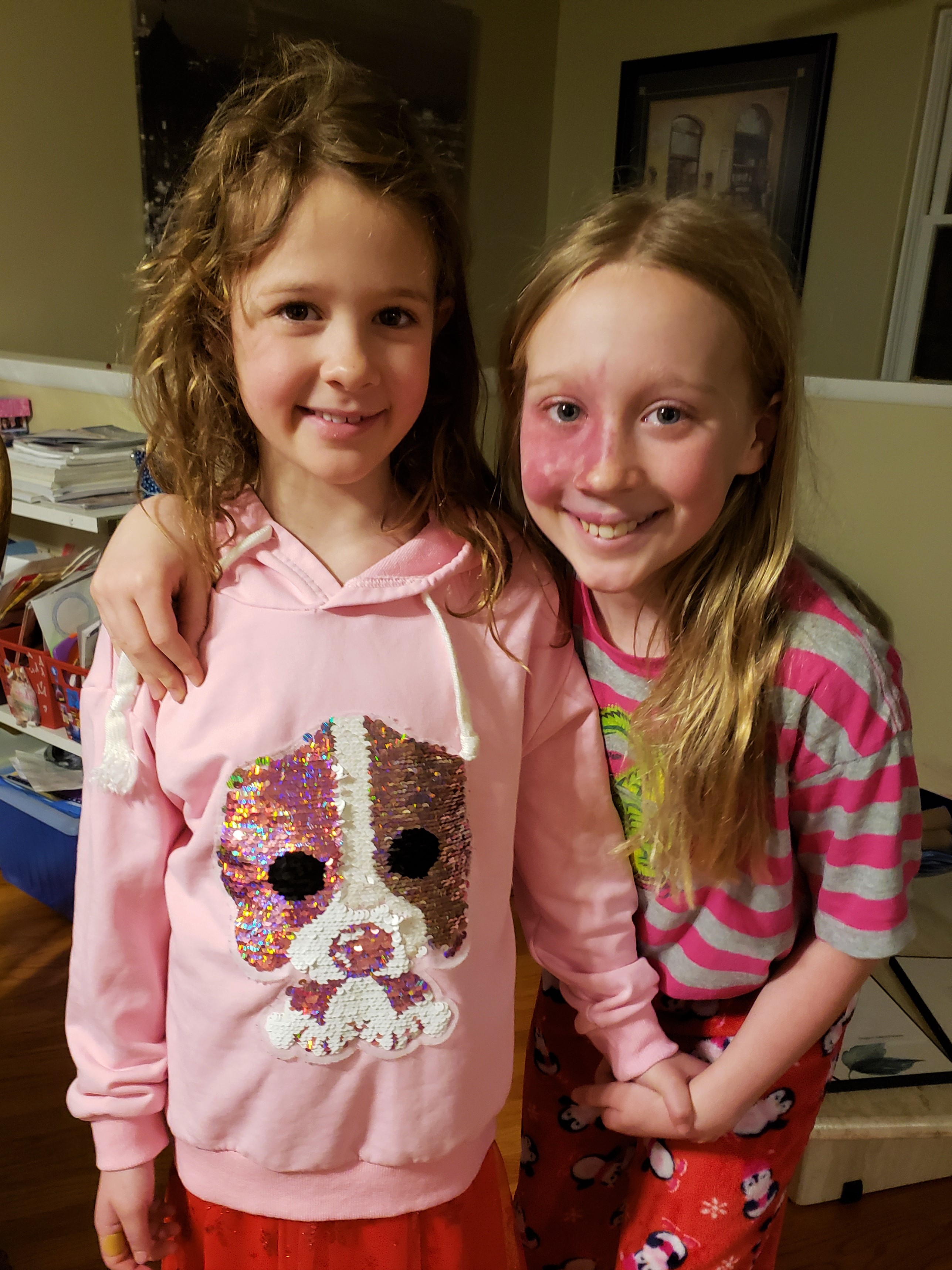
Addy feels a lot of camaraderie in this world. Sometimes she shares common features, clothes, or interests with other humans, even if she doesn’t quite look like them. Sometimes she just shares ‘different’ with other humans, even if they have hardly anything else in common.
And she may never see a doll with a face like hers, or a Barbie with a face like hers, or a print model with a face like hers, but that’s okay; she’s seen cupcakes and sweatshirts and flowers and a hundred other wonderful things ‘just like’ her, and that feels good, too.
You may have to open your eyes just a little wider than normal to see your abnormal child’s ‘likeness’ in the world around you – but pretty soon, you’ll start seeing it everywhere. Point it out, often, because your child may not pick up on such similarities on their own, and you don’t want them growing up without this skill to spot camaraderie in unexpected places. Point out any shared trait, any similar uniqueness, and any inanimate object even remotely resembling your child’s odd feature – point it out, and say, “Look at that! Just like you!”
This world can feel isolating sometimes, even for those of us who don’t stand out in a crowd. The more your child learns to spot the similarities, the less likely they’ll be to feel alone for too long. Because at some point a flower will bloom, or a cat will walk by, or a leaf will fall with markings ‘just like’ theirs, and they’ll be reminded to keep their eyes open for likeness in unexpected places. There’s always something in common – even if not, exactly, their face.

Parenting Strategy #5: On Makeup
Continuing my theme of ‘Strategies for Parenting a Unique Kid’ (see #1-3 here and #4 here), allow me to share with you my thoughts on…
Makeup.
Parenting Strategy #5: Teach her to Enhance, not Hide
I remember an informal debate arising among my college friends about why we women wear makeup. An answer was, of course, was never conclusively reached, but I found the arguments intriguing. They mostly seemed to agree with the premise that makeup was a shallow but necessary evil, the sad product of our modern culture’s social pressures. (One or two might have gaily dissented, asserting that wearing makeup is just plain fun.) But most of the debate revolved around why we liberated women all get sucked into wearing it anyway.
Some friends said they felt pressure to cover up their natural face, because that’s just what we all do, and they’d look ‘weird’ in public without it. Others said that men were expecting it, making it hard to navigate the single scene otherwise, and they’d never wear makeup if only women were around. Yet others said we really only wear it to cattily impress other women, never men, and there would definitely still be pressure to cover up our natural faces on a women-only desert island.
I disagreed with the premise underneath these arguments. I didn’t think of makeup as a shallow, necessary evil. And while I certainly couldn’t speak for all women, I didn’t think society pressure in whatever guise need be the primary driver behind it.
Makeup doesn’t need to hide or change us (as the debate seemed to assume); rather, it can enhance and frame the beauty that’s already there. I wasn’t wearing makeup because I felt ugly; I was wearing it because I felt beautiful.
After all, you don’t frame a work of art because it’s ugly, you frame it because it’s beautiful – so beautiful that it’s worth a gorgeous setting. Like a diamond elevated in its precious-metal ring. Can a Van Gogh stand on its own? Sure, but why not surround it with an amazing frame? A great frame doesn’t obscure the artwork; rather, it announces, “Ta-daah! Isn’t this gorgeous?”
And that, I asserted, is what makeup does. The rouge added to our cheeks isn’t unnatural; it’s an enhancement of the color already there. A line on our eyelid follows the eyelash line that’s already there. A dash of contour enhances the shadow implied by our natural bone structure.
When done well, makeup (and clothing, and jewelry, and any other enhancement you may feel guilty for using) draws attention to the beauty that’s already there.
Part of makeup’s usefulness comes, counterintuitively, from making a face look more naturally like itself. It diminishes eye-catching distractions like acne or dark circles, deviations that show up when I get less sleep and health than my skin needs, so there’s no guilt covering them up. It’s okay to eliminate those distractions and let my natural face shine through.
Right?
Right. Easy. Made total sense.
I enjoyed a guiltless makeup routine for years.
Until… Addy came along.
Suddenly, with Addy, the debate exploded into my mind all over again; because now, this little human was watching me, and she had a face with a Thing on it – a face that I wanted her to proudly show the world in full unmodified beauty someday. Why on earth was I applying makeup in front of her? What pressure was I feeling? What message was I sending?
With three children ages three and younger, the dark circles under my eyes had taken on a touring-with-the-Stones intensity, and I covered them up daily. But… why? (Other than the legit concern that I might be questioned about escaping from a rehab facility if I didn’t.) Just because I have an imperfection, do I need to cover it up? Who am I trying to impress? How dare I use concealer in front of my marked daughter? Am I setting her up to shamefully conceal her own lovely imperfection someday?
I was tempted to tell her to never ever use makeup. I was tempted to tell her that she’s so perfect, she won’t ever need it. I was tempted to tell her that it’s only society’s pressure that makes us want to wear the stuff anyway, and she’s above that.
Because I was terrified that she’d be tempted to use it someday, to cover her own face up, and that fear stopped me in my tracks.
In time, and after many guilt-ridden concealer purchases, I came back home to my original conclusion. I am the artwork; my makeup is the frame that enhances my beauty. Do I need it to ‘be pretty’? Not at all. But am I worthy of a lovely frame? Absolutely. When sleeplessness steals the color from my eyes, I can defend my face by enhancing what’s there – showing again the beauty that’s really naturally mine.
I wanted to help Addy understand makeup’s proper role (and avoid the pop-culture discomfort many of us feel around it). I wanted her to understand that she, too, could use makeup to enhance the beauty that’s already naturally on her face, if she wanted to. And, of course, I wanted her to see the port wine stain as part of that beauty – worth framing, rather than obscuring.
So I started talking through my makeup routine in positive terms when she was around. When I applied blush: “I LOVE having pink cheeks.” Or eyeliner: “It’s fun to make my eyes a little more visible.” Or eyeshadow: “I like the color of my eyes, so I pick an eyeshadow that helps bring out the color.” Or the emotionally-loaded concealer: “I like the color of my skin, so I’m using this to make it more consistent.” When wiping off an excess of any of it: “Whoops, that was too much. I almost covered myself up! I don’t want to do that.”
She now seems to view makeup as a good thing, not as a cover-everything escape. She sometimes adds blush to her other cheek before an event, so that it matches her port wine stain cheek. She plays with eyeshadows, dusting her lids and feeling glamorous. And sometimes she just slathers ALL the colors onto her face at once, because, hey, why not? Face color is fun.
Of course, the teenage years are around the corner, and I can’t promise that she won’t suddenly decide to cover it all up one day. The thought still scares me.
But I hope she will have learned by then that that’s not what makeup is for. I hope that, when she does start wearing it, she uses it to enhance, and not hide, what’s already there – including the right side of her face.
Talk your child into a healthy relationship with makeup. She will encounter it one day, whether you like it or not; by then, she should see it as a tool to enhance her beauty: nothing more, and nothing less. Provide a running commentary of comfort and confidence when she’s watching you do your makeup routine, whatever it may be. She’ll grow to see it not as a necessary evil, or a product of a deranged popular culture, but rather as something that can frame the beauty that’s already there.
It took me a long time to come to peace with the concealer in my makeup bag. I felt like a hypocrite. But covering exhausted eyes or irritated skin doesn’t mean I’m changing who I am. My natural features are still there. I’m worthy of a good frame. Our daughters are, too.


Parenting Strategies, Part 2: On Beauty
Continuing my last post’s theme of ‘Strategies for Parenting a Unique Kid’ (see #1-3 here):
I offer you another strategy we used when parenting Addy, in order to help her navigate the world with a big splotch on her face.
As you can tell, opening her eyes to all the beauty around her was a big theme for us…
Parenting Strategy #4: Go Beyond Features
Think of someone who’s drop-dead gorgeous. What do you see in them?
It might be certain features: sharp cheekbones, full lips, great hair, whatever.
But I’m willing to bet that something other than features caught your eye first. Poise. Posture. Carriage. Confidence. The stuff you don’t hear as much about in beauty magazines. That, I think, is what makes a human stand out to us visually.
The ‘beautiful’ that we find so attractive usually isn’t just in a person’s features. It’s in the way they carry themselves, the way they present themselves. Imagine the gorgeous person you thought of above spending three sleepless nights taking care of a kid with the flu. At the end of 3 days they’re slouching, they’re disheveled, they have dark circles under their eyes, their clothes are wrinkled, their hair is matted. If they shuffled into a room in that condition, they probably wouldn’t turn admiring heads, regardless of their otherwise lovely natural features.
I’ve seen girls who are strikingly tall and slender enough to be runway models carry themselves like they don’t matter, like they just want to disappear into the wallpaper – and, unfortunately, they too often succeed, hiding their striking features under an unconfident disguise. And I’ve seen average-featured women with stellar poise and posture walk into a room and turn heads like only movie stars can – because they carry themselves like they matter.
Poise. Posture. Carriage. Confidence. These make all the difference in the way we present ourselves to the world.
This is what your unique-looking child needs to understand. Someday, she’ll be tempted to feel that she’s not beautiful, because her features are not ‘like’ the beautiful people’s (whatever they may be at that moment in time). But if she understands that much of what we see as beautiful isn’t necessarily the features, as awesome and lovely as they may be, but rather the way we present ourselves to the world, then she’ll feel empowered to act and feel beautiful anyway.
Said another way: While we may not be able to control our natural features like height or birthmarks, we don’t have to feel ‘unbeautiful’ because of them. Because beauty is what we craft from the way we carry ourselves.
So: remember how I told you to teach her to spot the beauty in all the humans around her? With all their various features and their diverse physical traits? That’s important – keep doing it. Establish a wide definition of what traits ‘beautiful’ can include.
But don’t stop there – go beyond the physical traits, and start pointing out every instance of lovely poise, posture, carriage, and confidence you see.
Here’s what it might look like:
When you and your daughter are killing time in the dentist’s waiting room, and you’re flipping through a magazine filled with skinny women, and your daughter is looking over your shoulder, and you come across a story on Serena Williams, who clearly looks different from the print models, you point out her beauty like this: “Wow, she is gorgeous. Look at the way she looks straight at the camera. So poised and confident. That is beautiful.”
But then, don’t put down the skinny models! When you flip to a picture of a glamorous fashion model, you spot beauty there, too: “I love the way this model’s hair is swept up away from her face, up to the crown of her head! It makes a visual ‘line’ that draws attention to her cheekbones really well.”
You may be tempted to naysay the whole magazine, telling your child it’s dumb, shallow, and full of unattainable ideals. But that’s not a substantial enough response. It won’t keep her from someday being fascinated by those ideals anyway, and eventually even feeling like she doesn’t measure up to them. So meet that gloss head-on, and point to the beauty that’s there, without putting anyone down.
Here’s what this accomplishes: you’re bringing beauty out of the realm of ‘features you’re born with’ (as fabulous as they may be), and placing it solidly in the realm of ‘I’ve got this’.
Point out the beauty in every instance of lovely poise, posture, carriage, and confidence you see. It might be a bold smile. Bright eyes. Fabulous hair. An elegant gait. Even artfully-applied makeup or well-chosen clothing. Any intentional choice that enhances natural beauty is fair game. Point it out. Compliment it.
Because we can control the confidence we stand with, the way we look at a camera, the way we sweep up our hair. Our natural features, which we can’t control, don’t have to ‘make or break’ our beauty.
This will empower your child. Someday, when she’s tempted to quick-fix a single feature in a panic, like cover up a birthmark or crash-diet to skinny, she’ll already know that her whole beauty does not rely on a single feature. Rather, it is a constellation of so many things all at once, much of it beyond her physical traits, and solidly within her confident control.
Empower your child to understand this; point out the beauty you see. Help her spot it in the world around her. Don’t assume she’ll pick this up on her own. Poise. Eye contact. Posture. Relaxed shoulders. Carriage. Chin up. Confidence. Smile. All of these are within grasp.
Addy’s port wine stain will never ‘make or break’ her beauty. Because no feature can. Her beauty isn’t a hapless accident of physical traits. It’s something so much bigger. She’s got this.


A Few Parenting Strategies…

How do we raise a child to love her unique face? To be self-aware, without being self-critical? Prepared for, but not scared of, encounters?
Addy’s port wine stain forced us to think through parenting moments that might have otherwise passed without notice. Getting her to a point of comfort with her face (and keeping her there) took some careful attention.
Along the way, we developed some strategies for raising a unique-looking kid. Knowing that many of you, my dear readers, are also parents and grandparents, I share 3 of them with you here.
Some of these tips might seem incredibly obvious, but they don’t always flow from us naturally.
So, bear with me if I start by stating the obvious, but here, definitely at the very most-important top of the list, is “Parenting a Unique Kid” Strategy #1:
Parenting Strategy #1: Tell her she’s pretty.
It sounds so simple.
But there is so. much. cultural noise around raising females today. And, honestly, I disagree with many of the ‘enlightened’ modern directives: “Stop telling little girls they’re pretty, or they’ll never become scientists! Just tell them they’re smart and strong instead!”
Bah, humbug. As if we’re afraid that she’ll never accomplish anything if she thinks she’s pretty. As if telling her she’s a great engineer somehow conflicts with telling her she’s pretty.
Confidence is not a zero-sum game. Building up her confidence in one area of life (brains) doesn’t take away from another (looks). So we compliment both. Profusely.
The world around my daughter will tell her, whether through magazines, billboards, TV shows, movies, fashion, petty girlfriends and rude ex-boyfriends, that she’s not pretty. Whether that’s good or bad isn’t up for debate (it’s bad). But the fact remains that there will be a hundred different ways that the world tells her she’s not pretty.
It’s my job to tell her a hundred and one (at least) that she is.
Tell your daughter she’s pretty. You’re not making her shallow, and you’re not over-emphasizing looks when you do. It’s simply an insurance policy against the jabs that this world will sling at her.
And it’s the truth anyway (right?), so speak the truth. Don’t be afraid of it. Tell her she’s pretty. And that she can run the world. Those compliments don’t conflict, no matter how much our confused culture tells you they do.
We complimented Addy’s looks all the time, from her shiny little shoes to the port wine stain splotched on her face. This girl learned early & solidly that she’s pretty. Any weird encounters over her face couldn’t even begin to burst her confidence bubble. Calling her anything less than gorgeous would be like calling Mt. Everest an anthill: simply, humorously, Incorrect-with-a-capital-I.
Yes, she also knows she’s brilliant. And funny. And creative. And empowered. We built her confidence up in all those areas by affirming them verbally, all the time.
But she needed to hear she was pretty, before the world told her she wasn’t.
So don’t worry that you’ll ruin your daughter’s brains by calling her pretty. You won’t. Tell your little engineer that she’s beautiful. She needs to hear it.
Parenting Strategy #2: Tell Her You’re Pretty
Now, take it a step further: tell your daughter that YOU are pretty.
Seriously. Look into the mirror yourself and say out loud, “I feel really lovely today.”
I know, I know – the cultural noise says we’re not supposed to. “Don’t model vanity to your child! Teach her that looks don’t matter! Focus on other qualities instead, or she’ll become a petty, vain, critical woman!”
Well, at some point, she’s going to look into a mirror. Mirrors are a part of life. And our endless human striving for self-improvement means that she will find things to improve when she does look into a mirror.
The question is, will there be any other internal self-talk running in the background that keeps that self-critical drive in check?
“I feel really pretty,” is what my daughter has heard me say for years, when doing my makeup, checking my hair, pulling on a sweater, doing anything looks-related in front of a mirror.
I started talking to my reflection like that when Addy was a baby. I realized that I would need to model a healthy relationship with the mirror; after all, this was a baby whose every glance into every mirror would be a sharp reminder that her face is not like everyone else’s around her. Every glance would show her that her face has ‘something’ different on it.
And so, I decided to vocally associate Looking in the Mirror with “Self, you’re pretty.”
Addy caught on. She began to regularly smile every time she looked into a mirror. Because as far as she knew, that’s what we women do. Her reflection smiled back.
As you can probably tell from my stories here, she is not a petty, vain, critical female, even at eleven years old. She simply knows that her reflection is lovely, and that her port wine stain is part of that reflected loveliness.
Speak out loud. Your child can’t hear your internal monologue, so say it verbally for them. And if you don’t feel pretty today, then fake it ‘til you make it, and tell your reflection that you’re pretty, because your little copycat is listening.
Can I go even further?
Brace yourself.
I also say “Cool” every time I step on a scale.
Crazy! We’re supposed to never let our daughters see us step on scales, right? We shouldn’t even own a scale, right? Otherwise, we’ll all turn into self-hating weight-obsessed confused anorexics, right?
Wrong. In my opinion, weight is a simple, factual (and sometimes even helpful) number. Facts don’t have to be scary. Checking weight is a normal part of well-child pediatric checkups, pre-op appointments, and surgeries. It’s a number. Let it be so at home. Model that.
When you step on your scale to check your weight, nonchalantly say “Cool”, no matter what the number is. Because your child doesn’t need to hear a vacuum of silence around it.
You lay the groundwork for your child’s internal monologues. These are the lines that will be playing in the back of her head every time she makes a mistake, earns an achievement, puts on a new lipstick, walks into a new lunchroom, steps on a scale, and looks in a mirror. Don’t let her inherit a vacuum of silence from you, because there are other influences ready to fill the void with commentary about how she doesn’t measure up.
Instead, equip her with confident words. Show her what it looks like, teach her what it sounds like, to be comfortable with your own self. Your own reflection. Your own body.
You won’t make her vain or shallow. It’s cool. You’re beautiful. She’s beautiful. Speak it like it’s true.
Because it is.
Parenting Strategy #3: Tell Her Others are Pretty
Are you ready? Tell her others are pretty, too.
That’s right. I provide commentary on other humans’ beauty, too.
I can already hear the chorus of enlightened shouts: “You should never comment on any other woman’s physical qualities! You’re teaching your daughter to be critical and competitive! We’re above that!”
Again: beauty is not a zero-sum game. Confidence in my own beauty doesn’t diminish my recognition of yours. Likewise, recognizing your beauty doesn’t diminish confidence in my own. It’s not an ‘either-or’ proposition, it’s a ‘both-and’.
To put it in art terms, you can admire both the clear lines of a Renaissance masterpiece and the fuzzy impressions of a Monet without diminishing either work’s value to the canon.
In human terms, you can admire the delicate lightness of an Audrey Hepburn, the glamorous strength of a Serena Williams, the stunning height of a runway model, and the voluptuous curves of an Adele – all without diminishing your perception of the others’ (or your own) beauty. Appreciating one trait doesn’t have to reduce your appreciation of a different, or opposite, trait.
But here’s the catch, parents: Appreciation doesn’t always come naturally. Visual appreciation of great art doesn’t come naturally, or children would stare at a Titian instead of a tablet for hours on end. And visual appreciation of other humans definitely doesn’t come naturally, or world affairs would look quite different. It is up to us parents to endow our children with a deep appreciation of that which is truly beautiful in the world, including other humans.
Too often, we’re told never to comment on anyone else’s looks, because that should be left to our shallow, self-obsessed, critical, vain, popular culture, and we should be above that.
But if that’s the only commentary your child hears (and until a nuclear apocalypse wipes out said pop culture, your child will hear it), then you’ve left a vacuum of silence where there should be positive appreciation.
So compliment the beauty in others. Freely tell your daughter what you find beautiful. I’ve complimented many different birthmarks, skin tones, heights, ages, and weights to Addy. Thus, she has learned that there is beauty in those various birthmarks, skin tones, heights, ages, and weights (including, naturally, hers, wherever she may be in life).
Your commentary allows your daughter to begin spotting beauty in other humans to a greater degree of diversity than she might otherwise pick up on her own. You just have to help her spot it in the first place. This is critical. Don’t let her get silence from you on this.
Because later, she will be tempted to feel down on herself for not ‘looking like’ the Beautiful People… a feeling that usually rests on a pretty narrow view of beauty. The more variety she sees as beautiful now, the harder it will be to peg down exactly what requirement she’s not meeting later.
Point out the beauty in all the other humans; compliment a full spectrum of diverse features, so she learns to appreciate them all. Then she’ll learn to appreciate hers, too.
 Jennica
 What Happened To Her Face?